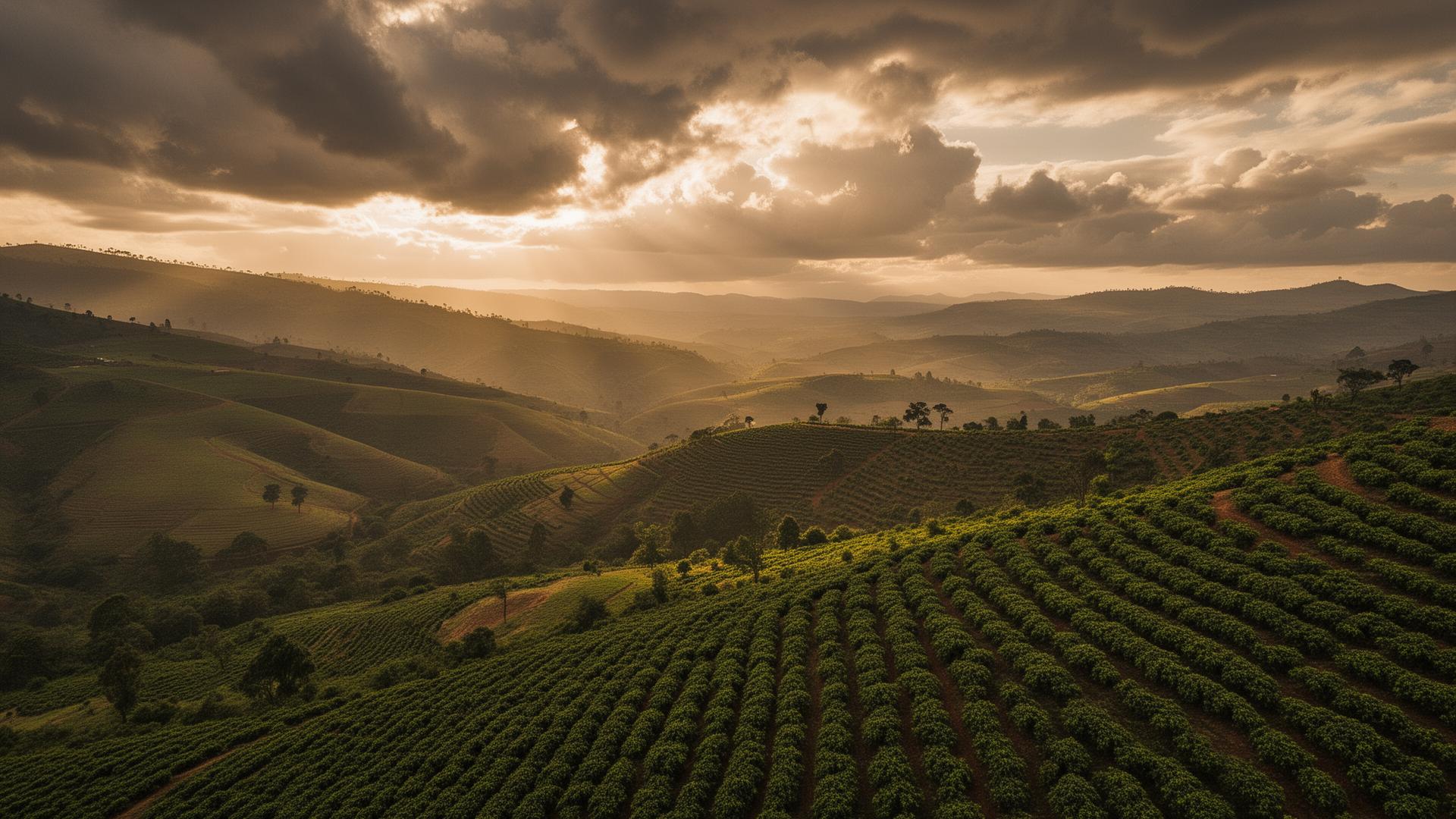
Why Ethiopian Coffee? The World's Most Complex Origin, Explained
Last updated: March 2026
Ethiopia isn't just another coffee origin — it's where coffee began. For specialty roasters and buyers seeking unmatched complexity, traceability, and genetic diversity, Ethiopian coffee stands alone.
Why Is Ethiopia Called the Birthplace of Coffee?
Ethiopia is the birthplace of all Arabica coffee. The country's highland forests contain thousands of genetically distinct wild coffee varieties found nowhere else on earth. This unmatched genetic diversity is why Ethiopian coffees produce the widest range of flavour profiles of any single origin — from floral-citrus to berry-wine to chocolate-honey.
Every cup of Arabica coffee in the world traces its genetic lineage back to a single place: the highland forests of south-western Ethiopia. The Kaffa region — from which the word "coffee" itself is derived — is where Coffea arabica evolved as a wild understorey plant in montane rainforests thousands of years before it was cultivated.
This matters enormously for quality. While most coffee-producing countries grow a small number of commercially selected cultivars — often just Bourbon, Typica, Caturra, or Catuai — Ethiopia's coffee forests contain thousands of genetically distinct wild and heirloom varieties, the majority of which remain scientifically unclassified. Ethiopian farmers commonly refer to their coffee simply as "regional landraces" or "JARC selections" because the genetic pool is so vast and varied.
This extraordinary genetic diversity is the foundation for the flavour complexity that makes Ethiopian coffee unlike any other origin on earth. When a roaster cups a washed Guji lot and discovers jasmine, bergamot, and white peach in a single cup — that complexity is the direct expression of genetic material that exists nowhere else in the commercial coffee world.
For specialty coffee buyers, this has a practical implication: Ethiopian lots offer a range of cup profiles that would require sourcing from multiple countries if you tried to replicate it elsewhere. A single Ethiopian exporter's portfolio can span floral-citrus (Yirgacheffe), stone-fruit-jasmine (Guji), berry-wine (Harrar), and chocolate-honey (Limu) — all from one origin country.
What Makes Ethiopian Coffee Terroir Unique?
Terroir — the combination of soil, altitude, climate, and agricultural practice — defines coffee quality at the lot level. Ethiopian coffee benefits from terroir conditions that are among the most favourable anywhere in the world for specialty coffee production.
Altitude: 1,500–2,200m
Ethiopian specialty coffee is grown at some of the highest altitudes in the coffee world. At 1,800–2,200 metres, cherry maturation slows dramatically — sometimes taking 9–10 months from flowering to harvest. This extended development period allows sugars, organic acids, and aromatic precursors to accumulate in the seed, producing the intense flavour complexity that defines top-scoring Ethiopian lots. The correlation between altitude and cup quality is well-established in SCA scoring data: the highest-altitude Ethiopian lots consistently achieve scores of 87 and above.
Volcanic, Mineral-Rich Soils
The Ethiopian Rift Valley and surrounding highlands sit on ancient volcanic geology. The resulting soils — typically deep red Nitisols — are naturally rich in iron, phosphorus, and organic matter. These minerals directly influence the chemical composition of coffee cherries and contribute to the pronounced acidity, sweetness, and body that characterise Ethiopian lots. The best-scoring lots from Guji and Yirgacheffe consistently come from farms on well-drained volcanic slopes with deep organic soil profiles.
Ideal Climate Patterns
Ethiopia's bimodal rainfall pattern — a long wet season (June–September) followed by a dry harvest period (November–January) — creates near-perfect conditions for cherry development and drying. The wet season supports vigorous vegetative growth and cherry filling, while the dry season allows uniform cherry ripening and clean drying conditions. This natural cycle reduces the need for mechanical drying and supports the natural sun-drying process that produces some of Ethiopia's most distinctive cup profiles.
Shade-Grown Agroforestry
The majority of Ethiopian specialty coffee is grown under native shade canopy in traditional agroforestry systems. The Gedeo agroforestry system — which covers much of the Yirgacheffe growing area — is recognised by UNESCO as a model of sustainable agriculture. Shade trees slow cherry maturation (further enhancing complexity), maintain soil moisture, cycle nutrients, and support biodiversity. For EUDR-conscious European buyers, this means Ethiopian shade-grown coffee is inherently aligned with deforestation-free sourcing requirements.
Ethiopia's Key Coffee Regions
Each Ethiopian growing region produces coffees with a distinctly different cup character — a diversity unmatched by any other origin country. We export traceable, SCA-scored lots from all major regions.
Guji
SCA 85–92Bright citrus, jasmine, stone fruit — Ethiopia's most sought-after specialty origin
View OriginYirgacheffe
SCA 87–91Floral, bergamot, lemon zest — the benchmark for washed Ethiopian coffee
View OriginSidama
SCA 85–88Berry, wine-like, chocolate — rich complexity with approachable sweetness
View OriginHarrar
SCA 84–87Blueberry, dark chocolate, spice — Ethiopia's legendary dry-processed origin
View OriginLimu
SCA 84–86Honey, balanced sweetness, mild fruit — a versatile and underrated origin
View OriginKaffa
SCA 83–86Wild, herbal, forest honey — the birthplace of Arabica itself
View OriginQuality Credentials
Ethiopian specialty coffee consistently achieves among the highest SCA cupping scores of any origin. Our exportable lots typically score between 85 and 92 points on the SCA 100-point scale, with exceptional micro-lots occasionally reaching 93+. These scores are verified by independent, licensed Q-graders using standardised SCA cupping protocols.
Ethiopian coffee has a remarkable track record in global competition. Ethiopian lots have been used by multiple World Barista Championship finalists and winners. The country's coffees are regularly featured in "best of" lists published by Sprudge, Perfect Daily Grind, and Barista Magazine. For roasters, an Ethiopian offering is not just a menu addition — it's a credibility signal to knowledgeable consumers.
In commercial terms, Ethiopian specialty coffee commands a significant premium over commodity-grade Arabica. Current specialty-grade Ethiopian green coffee trades at 2–4x the ICE Arabica futures price, reflecting the quality premium and traceability that buyers value. However, when bought direct from an Ethiopian exporter at FOB pricing, the cost-to-quality ratio is significantly more favourable than buying the same coffee through multiple intermediary layers.
Why Direct from Origin Matters
The traditional Ethiopian coffee supply chain involves multiple intermediaries: local collectors, ECX (Ethiopian Commodity Exchange) traders, domestic consolidators, international trading houses, and destination-country importers. Each layer adds cost, reduces freshness, and dilutes traceability. By the time a bag of Ethiopian green coffee reaches a European or American roaster through conventional channels, it may have passed through 4–6 hands — and the roaster often cannot trace the coffee back to a specific washing station, let alone a farm.
Buying direct from a licensed Ethiopian exporter changes this equation fundamentally:
- Better pricing: FOB Djibouti pricing eliminates intermediary margins. Buyers typically save 15–30% compared to equivalent quality purchased through importers.
- Fresher crop: Direct shipments from Ethiopia reach you faster. Our average transit time from order confirmation to port arrival is 4–6 weeks — versus 3–6 months through traditional channels.
- Full traceability: Every lot we export includes named washing station or farm, GPS coordinates, altitude, harvest date, processing method, and an independent SCA cupping report. This level of documentation is essential for EUDR compliance and increasingly expected by specialty consumers.
- Relationship continuity: Direct trade creates a long-term relationship with your source. You can request specific lots, reserve capacity from specific washing stations, and plan your purchasing around the Ethiopian harvest cycle.
Ready to Taste the Difference?
Request a free cupping sample from any Ethiopian origin — dispatched within 3 business days. No obligation, no minimum commitment.